What is vascular assessment?
Vascular assessment looks at the circulation supplying your lower limbs and feet. It helps assess arterial blood flow reaching the tissues and can identify signs that circulation may be compromised.
Good circulation is essential because blood delivers oxygen and nutrients to the tissues. This is particularly important for maintaining healthy skin, supporting tissue repair and allowing wounds to heal.
Poor circulation can increase the risk of complications, particularly in people living with diabetes or peripheral arterial disease (PAD).
What is a Doppler assessment?
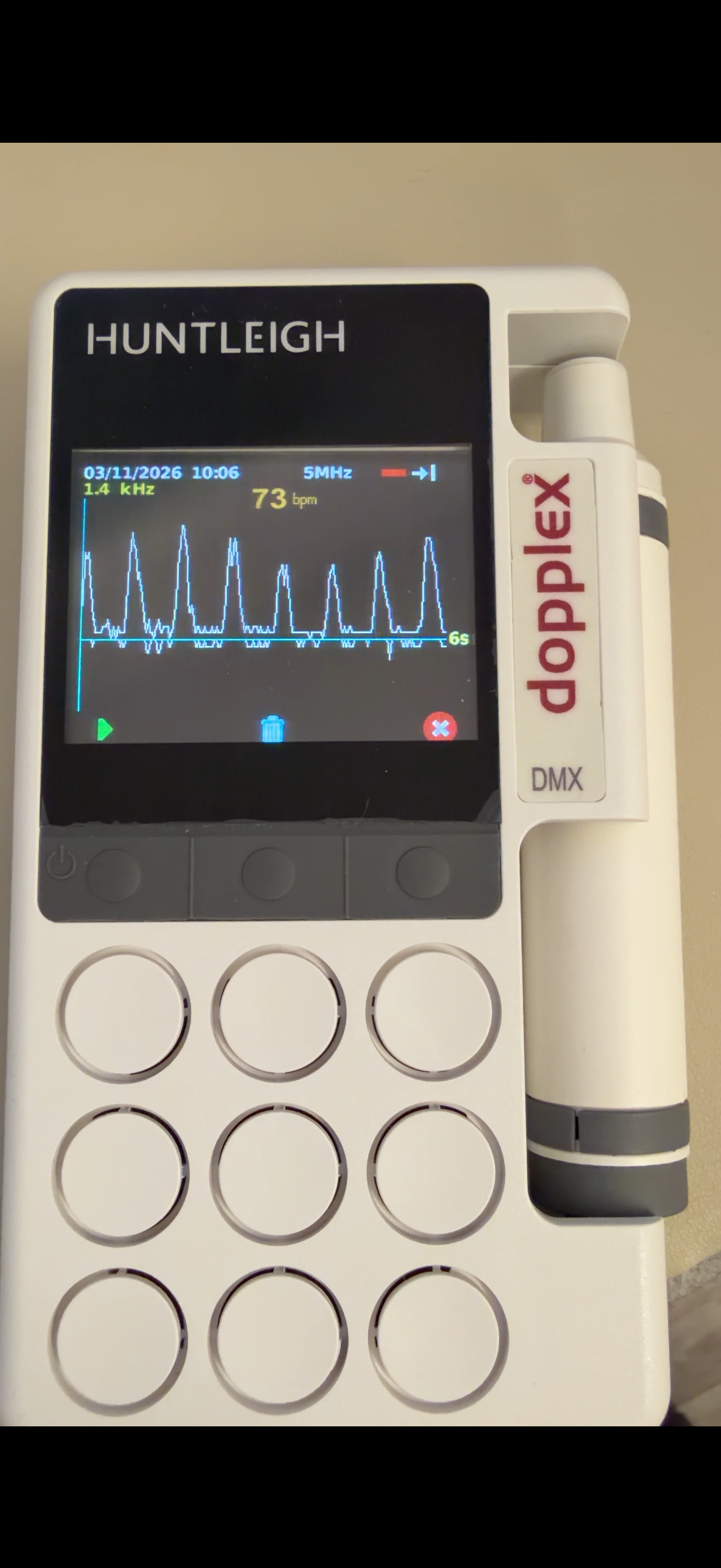
One of the pieces of equipment I use in clinic is a DMX Huntleigh Doppler.
A handheld Doppler uses ultrasound technology to detect blood flow through the arteries. It allows me to listen to arterial signals and assess their waveform characteristics.
During an assessment, I may examine the dorsalis pedis and posterior tibial arteries, which supply blood to the foot.
I'm looking at more than simply whether a pulse can be detected. The quality and characteristics of the Doppler signal provide valuable clinical information about arterial blood flow.
What does a Doppler waveform tell us?
Doppler waveforms can demonstrate different patterns of arterial blood flow.
Broadly, these include:
Triphasic: A waveform demonstrating three distinct phases, traditionally associated with normal peripheral arterial haemodynamics.
Biphasic: A waveform demonstrating two phases. This can be seen in different clinical circumstances and needs interpretation alongside other findings.
Monophasic: A waveform demonstrating a single-phase pattern, which can be associated with arterial disease and warrants further vascular assessment.
It is important to remember that waveform morphology should never be interpreted in isolation. A triphasic waveform does not automatically exclude peripheral arterial disease, just as a biphasic waveform does not necessarily confirm it.
Waveforms must be considered alongside pulse palpation, symptoms, clinical history, pressure measurements where indicated and the wider clinical presentation.
Why does circulation matter so much for your feet?
Reduced arterial circulation can affect the health of your feet in several ways.
Some potential warning signs include:
Feet that feel unusually cold.
Changes in skin colour.
Reduced hair growth on the lower legs.
Leg discomfort or cramping when walking.
Wounds or breaks in the skin that are slow to heal.
Changes to the skin and toenails.
Not everyone with peripheral arterial disease experiences obvious symptoms, which is why appropriate assessment is important.
If you notice persistent symptoms or changes in your feet, seek advice from your GP or an appropriate healthcare professional.
For further information, visit the NHS guide to peripheral arterial disease.
Why is vascular assessment particularly important for people with diabetes?
Diabetes can increase the risk of developing peripheral arterial disease and can also affect nerve function.
This means some people may have reduced sensation and may not recognise injuries, pressure damage or changes to their feet as readily.
Regular diabetic foot assessments help identify potential risk factors and ensure that appropriate care and onward referrals are arranged when necessary.
Depending on the clinical findings, vascular assessment may include:
Palpation of peripheral pulses.
Handheld Doppler waveform assessment.
Ankle-brachial pressure index (ABPI) measurements where indicated.
Further vascular investigations if concerns are identified.
Importantly, a normal or raised ABPI result alone does not always exclude peripheral arterial disease in people with diabetes. Arterial calcification can make blood vessels less compressible, potentially producing misleading pressure readings.
This is why interpreting vascular findings in the context of the patient's overall clinical presentation is so important.
You can find out more about diabetic foot checks through Diabetes UK.
What does 73 beats per minute mean?
The Doppler recording featured in this article demonstrates a pulsatile signal with a recorded rate of 73 beats per minute (bpm).
For most adults, a resting heart rate between 60 and 100 bpm is considered typical.
However, it is important to understand that heart rate and the quality of arterial circulation are two different things.
A reading of 73 bpm tells us the frequency of the pulsatile signal, but it does not independently confirm that circulation to the feet is healthy.
The waveform characteristics and wider clinical assessment are what help build a more complete picture of vascular health.
Looking after your foot health
Your circulation is an important part of your overall foot health, and understanding your individual vascular status can help identify potential problems early.
At Bailey Podiatry & Reflexology, I take a patient-centred approach to foot care, combining clinical assessment with appropriate treatment and advice.
Whether you're attending for routine podiatry, diabetic foot care or help with a specific foot concern, your circulation is an important part of the bigger picture.
Your feet do a lot for you. Make sure you're looking after them!
Further information and clinical references
The information in this article is supported by recognised clinical guidance and patient resources:
National Institute for Health and Care Excellence (NICE). Peripheral arterial disease: diagnosis and management (CG147).
Diabetes UK. Your annual diabetes foot check.
Royal College of Physicians. Peripheral arterial disease: NICE guidance.
This article is intended for general educational purposes and does not replace an individual clinical assessment or medical advice.
Need advice about your foot health?
If you have concerns about your circulation, changes in your feet or would like to arrange a podiatry assessment, I'd be happy to help.
Book your appointment today:
📍 The Glen, Main Street, Brampton, CA8 1SB
📞 016977 2191
💻 www.baileypodiatry.co.uk/book
We’re here to help you put your best foot forward — comfortably and confidently.
Bailey Podiatry & Reflexology
Supporting your foot health – and your whole wellbeing